Every automation conversation we have starts the same way: someone describes an AI feature they saw somewhere, and by the end of the call we’re usually talking about something much less exciting — and much more valuable.
Start with the boring task, not the exciting one
The fastest return on an automation project almost never comes from the most sophisticated part of the business. It comes from the most repetitive one: the order confirmation someone copies from one system into another by hand, the customer update sent the same way forty times a day, the report someone assembles every Friday from three different exports.
That work is boring precisely because it’s predictable — which is exactly what makes it automatable. Before we talk about AI, we look for the manual, repeated steps that already have a clear right answer. Those are the ones a workflow can take over completely, freeing up hours without anyone having to trust a judgement call to software.
Where workflows connect the dots
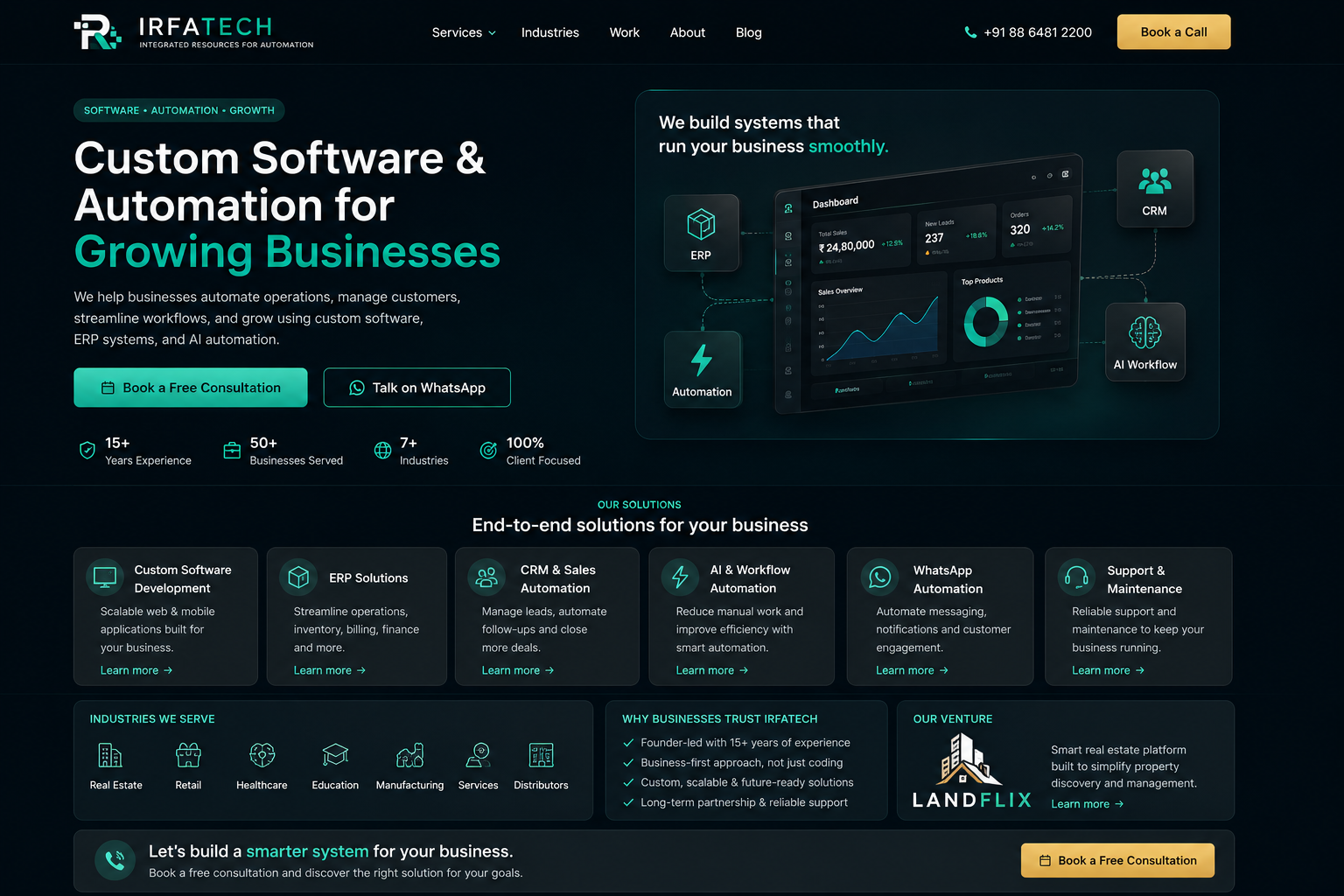
A lot of “automation” is really just plumbing: making sure your ERP, your CRM, and your website talk to each other so nobody has to. A new lead on your website should land in your CRM without someone re-typing it. A confirmed order in your ERP should trigger a WhatsApp update to the customer without a person in the loop. None of this needs AI — it needs the systems connected properly, which is often the higher-value, lower-risk half of an automation project.
Where AI actually earns its place
Once the plumbing is in place, AI is useful for the parts that genuinely need judgement at scale: summarising a long customer thread so a support agent doesn’t have to read it top to bottom, sorting incoming enquiries by what they’re actually about, or routing a request to the right person instead of a shared inbox. Used this way, AI is doing something a rule-based workflow can’t — not replacing a person, but saving them the first five minutes of every task.
What we don’t do is bolt AI onto a process for the sake of it. If a simple rule solves it, we use the simple rule. It’s cheaper to build, cheaper to run, and there’s nothing to explain when someone asks how a decision was made.
What this looks like in practice
For most of the SMBs we work with, automation starts with WhatsApp — order updates, appointment reminders, and routine customer replies handled without a person typing the same message for the fortieth time that day. From there it extends into the CRM and ERP, so the data behind those messages is accurate without manual entry.
If you’re not sure whether your business has “an automation problem,” it usually shows up as one specific task everyone complains about. Tell us what that task is — the free consultation is built around finding exactly that.